Book of Saphah
Chapter 4
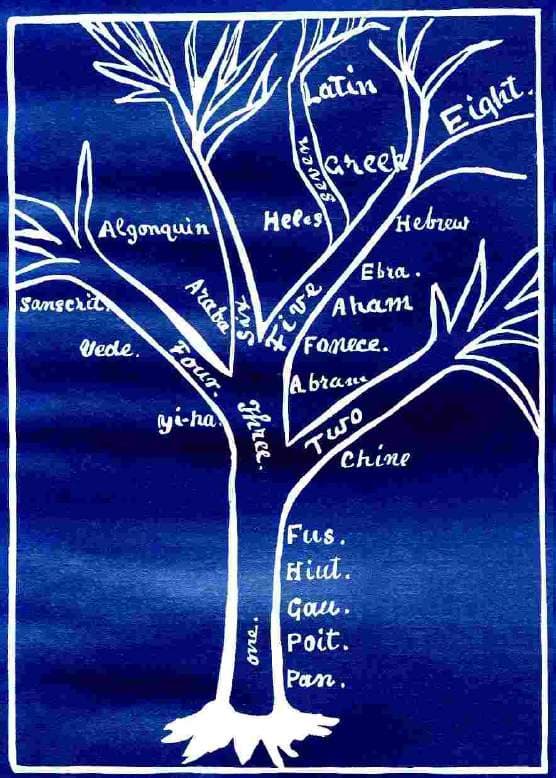
In ancient times the mouth was seldom closed in the act of speaking, and the words were formed mostly at the posterior of the palate and thorax. The letter A in English, had its equivalent in the ancient languages, but nearly the same as the English Au, and not much unlike the caw of a crow. The Chinese Ang is almost the same as the Ong of the Algonquin. U long often has the sound Yu’s, and sometimes of E only. U short is the same in all languages, and the same today as it was thousands of years ago. By using the root of the tongue instead of the tip, it is much easier to speak the Hebrew and Algonquin; and by allowing the sound to escape with the mouth nearly closed, it is easier to speak [East] Indian and Chinese. For House the Chinese word is Oke, and the equivalent in Hebrew is Ohel (home) [The Hebrew “h” is pronounced “kh” as in a small explosion from the back of the throat.], and L is so slightly sounded that when one hears an unlearned Hebrew say Ohel, it is impossible to distinguish the word from the Chinese Oke. The learned among the Hebrews use the word Bayith instead of Ohel. When we say “The House of Lords” we do not mean the building, but the collective body of noblemen, and in this sense the much-learned Hebrew scholar is further away from the origin of words than is the unlearned. Literal translations are not as true, in fact, as is the spiritual inception. By a residence among the illiterate Chinese, Hebrews and North American Indians (the Algonquin) more truth of the origin and use of primitive language can be learned than in the wisest of the classical books. The letter is arbitrary and unable to give the phonetecy [actual sounds], and after passing two or three languages, is too badly disfigured to be recognized. This rule must be followed by the student of philology who desires to learn whether the great languages of today sprung from some great nation that is now extinct. Nor are there any books more valuable to the student than is a residence of four or five years with each and all these four great peoples [Native Americans, Chinese, Hebrew, Indians (India)], and then not more with the learned than with the rural and unlearned. _ _ _ _ _ _ _ _ The Signature
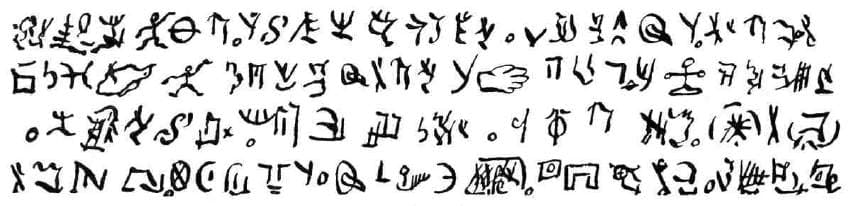
Editor’s Note: The Signature (image i041) is most likely written in the Panic tongue. In the 1882 and 1891 Oahspe editions, this plate was placed between the end of the Book of Fragapatti and the start of Book of Divinity. No explanation was given as to its meaning. It is placed here next to the language primaries as a candidate for translation. –ed. Panic, Yi’haic, Vedic, Hebraic and Sanscrit Primaries
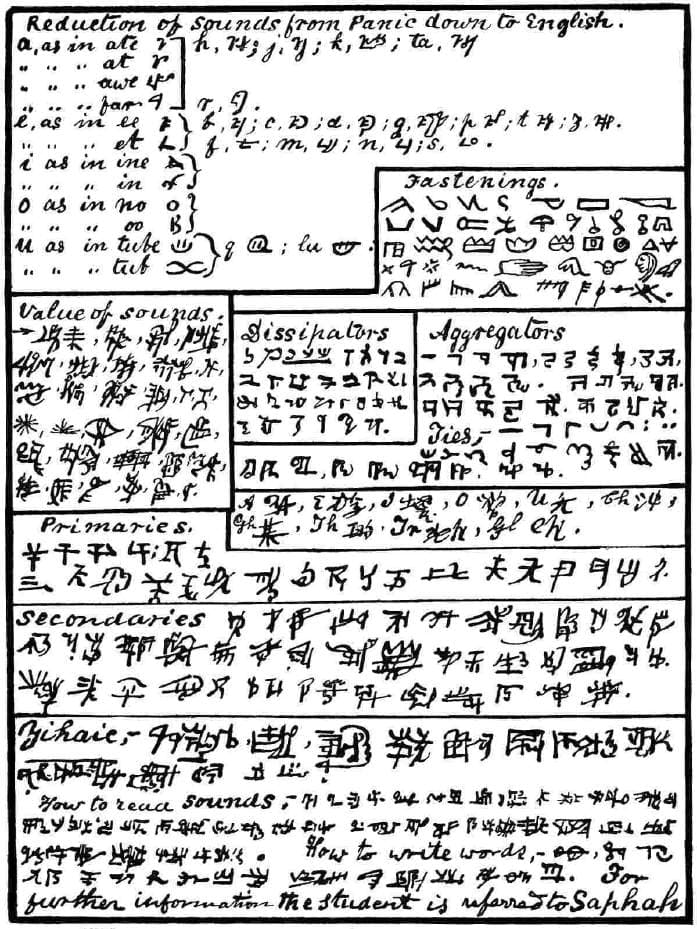
For the Panic, Yi’haic, Vedic, Hebraic and Sanscrit Primaries image (i042), here are the English words in the graphic: Reduction of sounds from Panic down to English. a as in ate, a as in at, a as in awe, a as in far, e as in ee, e as in et, i as ine, i as in in, o as in no, o as in oo [look, book –ed.], u as in tube, u as in tub. h, j, k, ta r b, c, d, g, p, t, z q, m, n, s q, lu Fastenings. Value of sounds. Dissipators. Aggregators. Primaries. Secondaries. Yihaic [Yi-ha –ed.], How to read sounds. How to write words. For further information the student is referred to Saphah. Tablet of Ah’iod’zan
Plates in this chapter