Book of Cosmogony and Prophecy
Chapter 8
Let ethe stand as one; ji’ay as two; a’ji as three, and corpor as four. To ethe give motion one hundred, or ninety-nine (as the case may be); to corpor give zero, that is, no motion (of itself); to ji’ay give sixty-six; to a’ji give thirty-three.
Ethe, being the time of light, is named dan; ji’ay, the time of fevers, epidemics, plagues; and a’ji, the time of wars, dashing forth with power and grasping; mi, the earth, being the subject.
There is still another period to all corporeal worlds, LUTS. In the time of luts there falls on a planet condensed earthy substances, such as clay, stones, ashes, disseminated molten metals, and so on, in such great quantities that it can be compared to snowstorms, piling up corporeal substance on the earth in places to a depth of many feet, and in drifts up to hundreds of feet.
Luts was called uz by some ancient prophets, because it was a time of destruction. If luts followed soon after a se’muan period, when portions of the earth were covered with se’mu and rank vegetation, it charred them, penetrating and covering them up. Most of the coal-beds and oil-beds in the earth were made this way.
Luts belongs more to an early age of a planet, when its vortex is more extended, and when the nebulous clouds in its outer belt are subject to condensation, so as to rain down on the earth these corporeal showers.
The time of dan is the opposite of this; and although it is the time of spirituality among mortals, and the time of prophecy and inspiration, yet it is the time the earth is rapidly giving off its life force and its moisture; rapidly growing old.
Consequently the two most important periods for the prophet’s consideration come within thirty-three and sixty-six, or, as they of old said, man and beast. In which measure man is divided into two parts (man and beast), and there is always a percentage in his behavior inclining to one or the other, and they correspond to the vortexian currents of the earth.
The student must not consider merely individuals, but nations, and peoples belonging to continents. And the relationship that comes of a’ji or dan, or their percentage, must have reference to those nations or peoples who manifest to its influence.
Thus, suppose a people’s grade runs below thirty-three, but not as low as twenty-two, and such a people fall under a’ji for a period of sixty-six years, or even more, then war, destruction, death and lust will come upon that people. But suppose the same fall of a’ji comes upon a people graded above thirty-three, to sixty-six, then war, and intellect, with oratory, music and remarkable men of genius will result. But, to carry it still further, the same fall of a’ji coming on a people above sixty-six, will cause them to manifest in many Lords, Gods and Saviors, and in superstitions, rites and ceremonies, which will all, more or less, pertain to sexualisms.
And so the prophet can determine, by the vortexian currents, the rise and fall of nations, and also comprehend how differently even the same showers and shadows of the unseen worlds will affect different peoples. And the same rules apply in the manifestation of dan; according to the grade of a people, so will they receive its light. If below thirty-three, they will become magicians and prophets without virtue; if above thirty-three, but below sixty-six, they will become self-opinionated malefactors, running into licentiousness for self’s sake. But if above sixty-six, they will become true prophets, abnegating self for the sake of righteousness.
Let the student compare the Faithists of Capilya in India with the Cojuans of the same country in the same period; and the Faithists of Moses in Egupt with the Eguptians of the same country and period. The Faithists of both countries advanced; but their persecutors both went down to destruction. The peace of the Faithists held four hundred years; and then both peoples began to choose kings, which was followed by nine hundred and ninety years of darkness.
So, whether the vortices show approaching light or approaching darkness, the prophet must bear in mind the grades of peoples. Any given light in the past among mortals, will thus show the date of its occurrence; while the heavenly lights will equally foreshow what will come upon any people.
It is not sufficient for man to know how to prophesy; but he must learn how to overcome the elements of his surroundings. As previously set forth, there are regions of drought on the earth, and these man must learn to overcome by causing rains to fall. He shall provide explosive gases high up in the air, which shall break the wind currents, establishing vortices from the upper regions downward.
And when an epidemic is predicted for a city, man shall dissipate the falling se’mu, and thus save it from destruction.
The inoculation, or vaccination, of flesh with poison (vaccines), to save it from poison (bacteria, virus, disease), is to use the battle-ax of satan. Man shall learn the higher law; to save by virtue instead of vice.
As to the grades, the student is referred to the books of Judgment, Knowledge and elsewhere in this Oahspe.
Prophecy is not guesswork. Absolute rules govern all things. A few individuals in a nation, or of a people, are a small matter. Nor must the prophet be swayed one fraction by the pretensions of a people. As for example, the Brahmins, Buddhists, Mohammedans and Christians, all profess faith in their respective Gods and Saviors; but their professions are false. Their faith is in soldiers, standing armies, and implements of destruction. The prophet must not, therefore, permit himself to heed individual explanations. He must grade them as a whole; whether they manifest below thirty-three, or above sixty-six, without regard to pretensions.
When the student has completed his tables of orachnebuahgalah, with the history of the period, and taken the measure of grades of the different nations and peoples of the earth, he will find that he can not only foretell the future, but he can discover the past history for an equally long period of time.
And when he has thus completed two cycles he can find a third, and then a fourth, and so on, until all the past history of the earth is delivered up to his understanding.
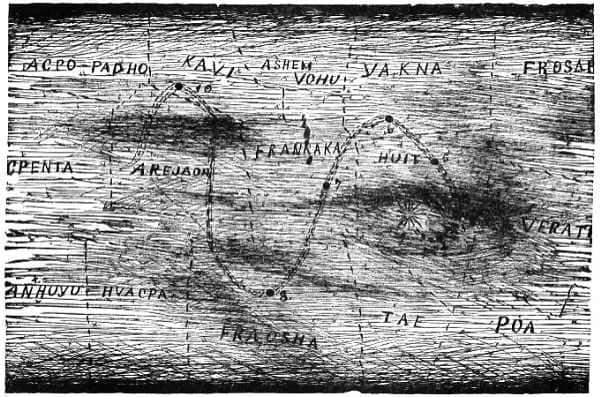
Plates in this chapter