Book of Cosmogony and Prophecy
Chapter 6
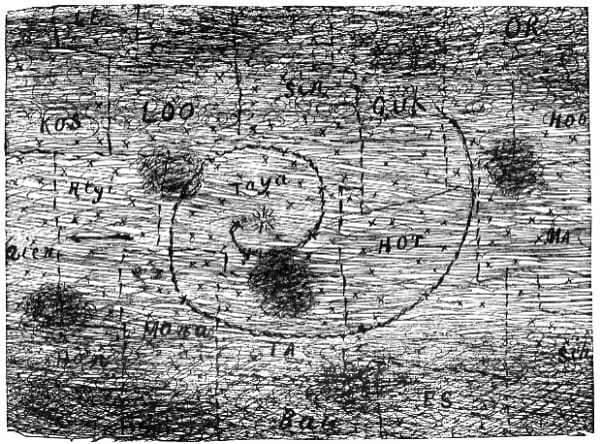
To return to the master vortex; refer to image TOW’SANG (i073). It is an error to say that the eye sees the sun by means of a straight line. The line of sight to the sun is spiral and oval. But it is equally an error to say that light comes from the sun to the earth, or to any other planet; which has given rise to the still greater errors of calculating the time of travel of light, and the degree of heat of a planet by its proximity to the sun.
To determine the distance of the sun from the earth, allowance must be made for the vortexian spirality. By which reason, the sun is, in fact, some seven million miles nearer to the earth than its measure would indicate. The same measurement rule applies to all planets except the moon. And even this is seen by means of the curved lines of the earth’s vortex.
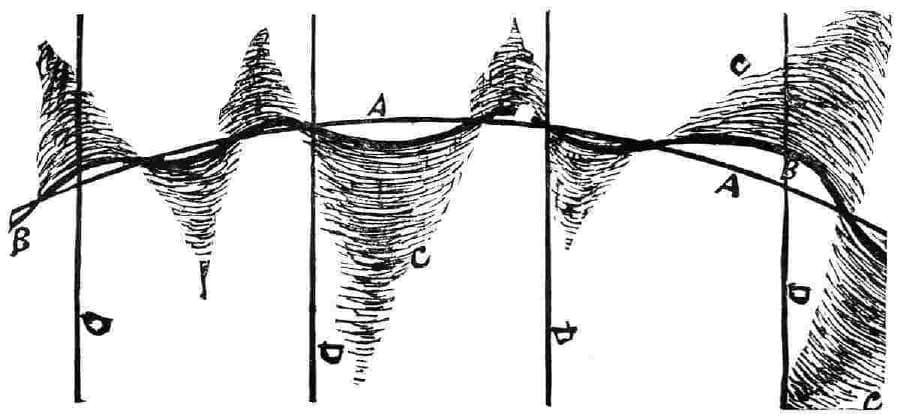
As the moon’s vortex rides around in the outer part of the earth’s vortex and we discover the moon’s elliptic course, so, similarly, we can discover by the roads of a comet, the spirality and curve of the master’s vortex. Observe a comet in different positions as it follows the sun’s vortex.
When the head of a comet falls within the overlapping waves of the sun’s vortex, the head is sometimes swallowed up, and sometimes driven backward, spitting flames of fire the entire time. The nearer the comet approaches an elliptic course, the longer it will live; the opposite condition applies to hyperbolic comets, for they often die or dissolve in one journey. If a comet is seen today in hyperbole, and in any angle of the heavens, and if, in ten years or a hundred years, a comet is seen in the same place, it would be an error to say it was the same comet.
It is an error to prophesy [estimate –Ed.], the heat of Venus being more or less because of her approximation nearer the sun. There is no more heat in the master vortex in general, than there is a hundred miles above the earth, except when very near the sun’s photosphere, that is to say, within one or two thousand miles at most.
There is a sun planet in the center of the photosphere, at a distance interior, from three thousand miles to thirty thousand miles, and it is light all the way around. But within the body of the photosphere there are numerous planets, some globular, some elongated and irregular. These are usually called sunspots; because when they present their negative surface [shadow side or cooler side] toward the earth they seem black. For the most part, these planets in the photosphere are rather external [near the outer edge of the photosphere] than internal at the times they appear as spots. They have independent motions [orbits, axial motion, etc. –ed.] in their respective places.
From which it may be said: When an unlearned man says: THE SUN, we know what he means; but when a learned man says: THE SUN, we do not know what he means, whether the whole central group, or the sun planet only.
If one were to go into a circular field, a little way from the middle, and there construct an electric battery, from which a multitude of wires are extended outward, to small batteries in distant parts of the field, the batteries would then represent somewhat the solar phalanx, the central one being the sun. There would be more volume of electricity manifested at the central battery; but the intensity of the spark at one of the small batteries would, other things being equal, be equal to the spark at the central battery.
Neither is there more intensity of heat at the sun, than in any electric flash. Neither must it be surmised that the sun center is an electric battery; nor that it supplies, in any sense, anything to any other planet. As previously stated, there are two things, corpor and ethe; the latter is the solvent of corpor. Whirling vortices of the etheic solution make planets. And these are the sum and substance of all things manifested in the universe.
It is an error to say the sun threw off rings or planets. No thing has power to throw off itself, or a part of itself, except some living creature. They have used, as an example, water flying from the periphery of a rapidly rotating wheel. This would merely imply that someone was trying to fasten worlds on the sun’s periphery, but that the sun cast them off. Who that SOMEONE was they do not say; nor do they offer a reason as to how such thrown-off substance came to be in the way of the sun in the first place.
It is equally erroneous to say that the presence of this or that planet, throws an influence on mortals, according to their birth under certain stars. It is this same astrological ignorance that attributes to the sun the throwing-off of light and heat, and of possessing attraction of gravitation, and of throwing off rings to make planets of.
For this and that, man has ever sought the cause in corporeal things; he builds up certain tables and diagrams, and calls it science or philosophy. If, one morning he puts on the left shoe first, and something happens that day, then by that shoe he proves a new philosophy. By the tides, he proves the cause of the moon; or by the moon, the cause of the tides. Yes, he searches for explanation by anything under the sun that is corporeal, rather than search in the subtle and potent, unseen worlds.
Let it be premised, then, that the etherean firmament (which the world’s people commonly call outer space or simply space) is not a waste and interminable nothingness; but that, on the contrary, it is in many regions, even between the earth and the sun, sufficiently dense for a corporeal man to dwell upon, and to walk about, even as on the earth. Some of these are as transparent as water or clear glass, and some opaque. Some of these etherean worlds are as large as the earth, and some a thousand times larger. Some are like immense facsimiles of snowflakes; with arches a thousand miles high and broad. Some of them are like oceans of water; some transparent and some opaque; and some of them are dense clouds of ashes. But so great are the numbers and so vast the varieties of these billions of etherean worlds, that description is impossible. Yet, by the telescopic power of the earth’s vortexian lens, these worlds are magnified so as to seem to be nonentities.
Worlds in solution, the etherean heavens, are therefore governed by no power in, or escaping from, corporeal worlds. In the language of the ancient prophets, they are a law to themselves. And yet these unseen worlds have much power and influence on the vortices of corporeal worlds.
When making observations with the spectroscope, these otherwise unseen worlds are sometimes seen; but usually the spectroscope reveals only the refraction of high altitudes in the earth’s vortex. It is an error to say the spectrum divides the sun’s rays PER SE. It is an error to say the spectroscope has revealed certain colors in the atmosphere or photosphere of the sun or other stars. Its revelations, for the most part, pertain to what is contained in the vortexian lens of the earth, no matter whether the view is toward the sun or another star. END COSMOGONY SECTION Prophecy Section
Plates in this chapter